Good TV brands in 2026
As an Amazon Associate I earn from qualifying purchases.Some links may earn us a commission at no extra cost to you.
Brand is a good starting filter, but the series is what decides brightness, motion, gaming features, and black levels. For most people, my #1 “real-life” deciding factor is HDR brightness (nits)—because it determines whether HDR still looks great in a normal living room, not just a dark basement.
How I researched
I compared recent TV roundups and spec sheets, prioritized HDR brightness as the primary “wow factor” in typical rooms, checked HDMI 2.1/VRR/120Hz+ for gaming, and weighed practical ownership stuff like glare handling, ports, and how consistent each brand’s midrange lines tend to be.
Top picks
Sony — Best for sports, movies, and “clean” upscaling
Sony is my safest brand for motion and processing—especially if you watch sports, cable, or mixed-quality streaming. If your room is bright, Sony’s brighter Mini LED lines are usually the best Sony fit.
Why it wins: strong processing + excellent motion, with high-end bright-room options.

- MINI LED BRIGHTNESS AND CONTRAST: Thousands of Mini LEDs are precisely controlled by XR Backlight Master Drive to deliver authentic contrast and our...
- BILLIONS OF REAL-WORLD QLED COLORS: Access billions of accurate real-world colors with QLED technology and XR Triluminos Pro.
- POWERFUL TV PROCESSING: XR Processor intelligently enhances every scene in real-time boosting color, contrast, and clarity.
- BEAUTIFUL PICTURE FROM ANY ANGLE: Beautiful picture from any angle – Get a premium picture, with reduced glare, from every seat in the room with...
Pros
-
Excellent motion for sports
-
Strong upscaling for older/low-bitrate content
-
Great for bright rooms (with the right series)
Cons
-
HDMI port layouts can be limiting on some models
-
Often costs more than value brands
Social proof: See reviews on Amazon.
Who should skip / failure cases: If I need multiple HDMI 2.1 devices plus a soundbar, I double-check ports first (or plan on an HDMI 2.1 switch/receiver). If I only watch in a dark bedroom, I usually get more value from OLED.
Scores: Performance 5/5 • HDR brightness 4/5 • Ease of use 4/5 • Value 3/5
LG — Best all-around OLED brand (movies + gaming)
LG is the default OLED recommendation because the lineup is consistent: deep blacks for movie nights, fast response for gaming, and strong feature support on the mainstream C-series.
Why it wins: OLED contrast + reliable gaming feature set.

- OLED Technology: Celebrating 12 years of perfecting award-winning OLED TV technology
- Brightness Booster: Our Brightness Booster technology magnifies each individual pixel for luminous quality that shines with every detail
- Bright Room Ready: Verified by UL for Discomfort Glare Free (UGR less than 22), you can be confident your LG OLED TV performs well no matter the room...
- Alpha 9 AI Processor Gen8: This processor is the brains behind a truly unforgettable TV experience. You'll get personalized smooth, vivid picture no...
Pros
-
OLED black levels (great for dark-room viewing)
-
Great gaming support on the right models
-
Solid “set it and forget it” picture modes
Cons
-
Not as bright as top Mini LED TVs
-
Burn-in risk with heavy static content (varies by use)
Social proof: See reviews on Amazon.
Who should skip / failure cases: If the TV runs all day on news or channels with static logos/tickers, I lean Mini LED. If the room is extremely bright, I consider a brighter Mini LED instead of OLED.
Scores: Performance 5/5 • HDR brightness 3/5 • Ease of use 4/5 • Value 4/5
Samsung — Best for punchy HDR and sleek smart features
Samsung’s higher-end TVs tend to look bold and vivid, and gaming features are usually strong. One common dealbreaker: many Samsung TVs don’t support Dolby Vision, so format preferences matter.
Why it wins: vivid HDR + strong premium features on the top tiers.

- OUR MOST ADVANCED 4K AI PROCESSOR: Powered by 128 neural networks to deliver AI-enhanced picture and optimized sound, resulting in an exceptional 4K...
- SAY GOODBYE TO DISTRACTING REFLECTIONS: Watch everything you love without distracting reflections so you can get lost in your content —even with sun...
- POWERFUL BRIGHTNESS AND DRAMATIC CONTRAST FOR STRIKINGLY LIFE-LIKE PICTURE: See new details and highlights pop off the screen. Our brightest OLED with...
- BRING SMOOTH MOTION TO SPORTS AND ENJOY VIRTUALLY TEAR-FREE GAMING: Experience smooth visuals and blazing fast speeds for VRR gaming at up to 4K...
Pros
-
Strong HDR impact on premium lines
-
Great gaming-focused features on higher tiers
-
Smooth, modern smart TV platform
Cons
-
Dolby Vision often not included
-
Quality varies a lot between budget and premium series
Social proof: See reviews on Amazon.
Who should skip / failure cases: If Dolby Vision is a must-have for my streaming setup, I compare Sony/LG first. If I use the TV as a close-up PC monitor, I verify text clarity feedback for the exact model.
Scores: Performance 5/5 • HDR brightness 4/5 • Ease of use 4/5 • Value 3/5
TCL — Best value brand for big screens with Mini LED
TCL is my value pick when I want a large screen plus strong brightness. The key is buying the right line—TCL’s better Mini LED series are the ones that compete with pricier brands.
Why it wins: big-screen brightness/features without premium pricing.

- QD-MINI LED: This premium level Mini LED TV, now with the New TCL Halo Control System, ensures a stunning viewing experience.
- TCL HALO CONTROL SYSTEM: An advanced Technology Suite that includes the New Super High Energy LED Microchip, Condensed Micro Lens, Micro-OD Reduced...
- CRYSTGLOW WHVA PANEL: Stunning picture quality from any seat with the anti-reflective edge-to-edge ZeroBorder* panel that’s designed to deliver...
- GAME ACCELERATOR 288: Win the game with up to blistering fast 288 VRR, creating lag-free gaming.
Pros
-
Very bright on the right Mini LED series
-
Strong value at 65″ and up
-
Gaming features can be excellent for the price
Cons
-
Motion/processing often trails Sony
-
Built-in sound is usually just “fine”
Social proof: See reviews on Amazon.
Who should skip / failure cases: If I’m extremely sensitive to motion in sports/cinema, Sony can look more natural. If I have wide seating, I check viewing-angle performance for the specific model line.
Scores: Performance 4/5 • HDR brightness 5/5 • Ease of use 4/5 • Value 5/5
Hisense — Best “most TV for the money” (when you pick the right tier)
Hisense is great when I want premium-ish features for less—especially in the U-series. Like TCL, the series matters a lot: entry lines can be basic, while higher lines are the real reason to buy the brand.
Why it wins: strong value with bright Mini LED options in the better series.
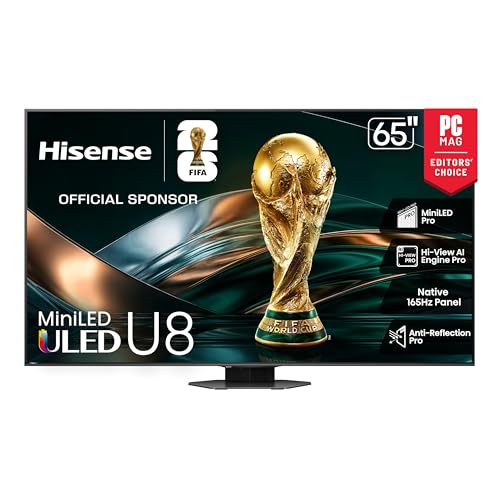
- MINILED PRO WITH UP TO 5000 NITS PEAK BRIGHTNESS AND UP TO 5600 LOCAL DIMMING ZONES: See the realism of every shadow cast by the players and the ball...
- HI-VIEW AI ENGINE PRO: Enjoy the game from home, but feel like you’re there. Powered by the Hisense proprietary chipset, Hi-View AI Engine Pro...
- NATIVE 165HZ PANEL WITH GAME BOOSTER 288: Turbo power your gaming! The Native 165Hz Panel has a Variable Refresh Rate of 48Hz to 165Hz, almost as fast...
- ENHANCED GAME BAR: Enjoy your gaming dashboard and manage performance in real time. Seamlessly adjust settings and monitor gameplay data as you play...

Pros
-
Strong features for the price on higher lines
-
Often excellent brightness for HDR (model-dependent)
-
Great size-per-dollar in many sizes
Cons
-
Entry models may be 60Hz with limited gaming
-
Quality can vary more than Sony/LG
Social proof: See reviews on Amazon.
Who should skip / failure cases: If I want guaranteed top-tier processing and motion, I usually pay up for Sony. If I want serious gaming (120Hz+), I avoid Hisense entry tiers and stick to the higher series.
Scores: Performance 4/5 • HDR brightness 4/5 • Ease of use 4/5 • Value 4/5
Quick compare
-
Best for sports + “looks good on anything”: Sony
-
Best for movie nights + gaming (dark room): LG OLED
-
Best for bold HDR + premium smart features: Samsung
-
Best big-screen Mini LED value: TCL
-
Best “features for the money” in upper tiers: Hisense
FAQs
What are the top 3 TV brands?
For most shoppers: Sony, LG, and Samsung. I add TCL and Hisense when value is the priority.
Is OLED always better than Mini LED?
No. OLED usually wins for dark-room contrast, but Mini LED often wins in very bright rooms and can be a safer choice for heavy static-content viewing.
Do I need 120Hz?
If I game (especially competitive) or I’m picky about smooth motion, yes. If I mostly watch movies and shows, it’s nice but not required.
What’s the biggest brand trap?
Buying a brand’s entry series expecting the flagship look. The series decides brightness, local dimming, motion, and gaming support.
As an Amazon Associate, I earn from qualifying purchases.