Beginner Telescopes for First-Time Astronomers
As an Amazon Associate, I earn from qualifying purchases. Some links may earn us a commission at no extra cost to you.
A useful first telescope needs more than a big magnification number. Aperture, mount stability, ease of aiming, portability, and optical design all affect how enjoyable a telescope is for a beginner. These seven picks cover computerized navigation, manual planetary viewing, reflector-based observing, travel, compact storage, budget-friendly learning, and family stargazing.
Top Picks
Celestron NexStar 102SLT — Best Beginner Telescope Overall
The NexStar 102SLT combines a 102mm refractor with computerized object finding and a full-height stainless-steel tripod. Its 660mm focal length provides a relatively broad field for general sky exploration, while the NexStar+ controller can direct the telescope toward objects after alignment.
The package includes 25mm and 9mm eyepieces, a red-dot finder, and a quick-release mounting system.
Why it wins: It combines useful aperture with computerized navigation while avoiding the routine mirror alignment associated with reflector telescopes.
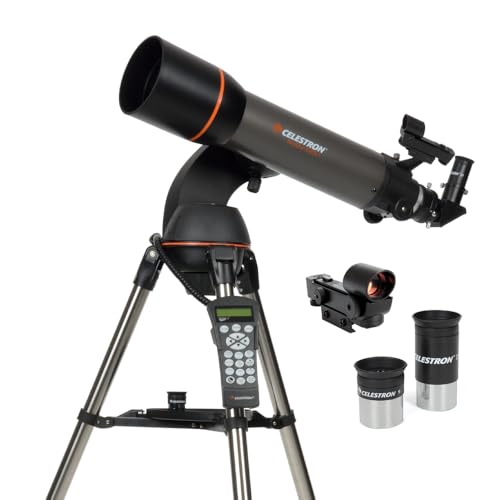
- COMPUTERIZED STAR LOCATING TELESCOPE: The Celestron NexStar 102SLT is a computerized telescope that...
- COMPACT AND PORTABLE: This telescope for adults and kids to be used together is ideal for weekend...
- REFRACTOR OPTICAL DESIGN: The NexStar 102SLT aperture gathers enough light to see our Solar System...

Pros
- 102mm aperture
- Computerized object locating
- Full-height stainless-steel tripod
- Two eyepieces included
- Refractor design requires little optical maintenance
Cons
- Alignment is more involved than a simple manual mount
- Requires batteries or external power
Trade-offs / Who should skip:
Choose a manual refractor if you want the simplest possible first-night setup. The NexStar 102SLT makes more sense for beginners who want help locating targets.
Hawkko 90mm 900mm Refractor — Best for Manual Moon and Planet Viewing
The Hawkko combines a 90mm aperture with a long 900mm focal length and a manual altazimuth mount. That format is particularly useful for beginners interested in the Moon, planets, and double stars without dealing with computerized alignment.
Its package includes a stainless-steel tripod, two eyepieces, finder, Barlow lens, phone adapter, and carrying bag.
Why it wins: The long focal length and straightforward manual controls make it a practical introduction to lunar and planetary observing.

- High Powered Astronomical Telescope: Hawkko telescope for adults and beginners offers 36X to 270X...
- Outstanding Optical Performance: This astronomical telescope is equipped with a 90mm large aperture...
- Flexible, Stable & Portable: Stable stainless steel AZ mount tripod supports smooth 360° rotation...
Pros
- 90mm aperture
- 900mm focal length
- Straightforward AZ mount
- Stainless-steel tripod
- Carry bag and phone adapter included
Cons
- Long optical tube requires more storage
- Manual mount does not automatically track targets
Trade-offs / Who should skip:
Choose a computerized telescope if manually finding celestial objects sounds frustrating. The Hawkko rewards users who want to learn basic sky navigation.
MEEZAA 150EQ Newtonian Reflector — Best Premium Reflector
The MEEZAA 150EQ introduces a Newtonian reflector to a lineup otherwise dominated by refractors and compact Maksutov designs. It uses an equatorial mount and comes with a tripod, phone adapter, Moon filter, and large carrying bag.
The equatorial setup takes more learning than a basic altazimuth mount, but it gives beginners a pathway into a more traditional astronomy-oriented observing system.
Why it wins: The reflector design and equatorial mount make it the strongest step-up option for beginners who want something more advanced than a basic starter refractor.
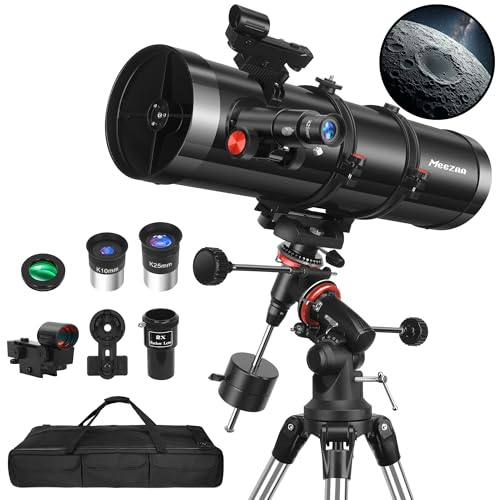
- 150mm Large Aperture: This astronomical reflector telescope for adults features a 650mm focal length...
- High Magnification & Clear Optics: Equipped with two eyepieces (25mm & 10mm) and a 2X Barlow lens...
- Stable German Equatorial Mount: Upgraded Equatorial mount with precision dials and slow-motion...
Pros
- Newtonian reflector design
- Equatorial mount
- Tripod included
- Phone adapter included
- Moon filter and large carry bag included
Cons
- Equatorial mounts require more learning
- Reflectors can require occasional optical alignment
Trade-offs / Who should skip:
Choose the NexStar 102SLT if automated object finding matters more than learning an equatorial mount. Beginners who want the simplest possible setup may also prefer a refractor.
EACONN 80mm 600mm Refractor — Best Travel Telescope
The EACONN uses an 80mm aperture and 600mm focal length in a portable refractor format. Its altazimuth mount keeps aiming straightforward, while the included backpack makes it easier to take the telescope on camping trips, road trips, or visits to darker observing locations.
A tripod and phone adapter are also included.
Why it wins: It balances useful beginner-level aperture with a format that is still practical to pack and transport.
No products found.
Pros
- 80mm aperture
- 600mm focal length
- Backpack included
- Simple altazimuth controls
- Phone adapter included
Cons
- Less light gathering than larger telescopes
- Not designed for advanced astrophotography
Trade-offs / Who should skip:
Choose a larger telescope if most observing will happen from one fixed location. The EACONN is better when portability is a major priority.
SARBLUE Mak70 — Best Compact Planetary Telescope
The SARBLUE Mak70 uses a 70mm Maksutov-Cassegrain optical system with a 1000mm focal length. Its folded optical path provides a long focal length without requiring the long tube of a comparable refractor.
The included slow-motion gimbal tripod also provides finer control when centering lunar and planetary targets.
Why it wins: It packs a long focal length into a particularly compact optical tube, making it appealing for apartments, travel, and planetary observing.

- 【Might Mak】Mak-cass design brings several benefits which distinguishes the telescope from...
- 【Compact & Powerful】Maksutov-Cassegrain optical design allows 1000mm focal length folded in...
- 【Micro Tripod Design】In pursuit of a more precise and comfortable calibration experience...
Pros
- Compact Maksutov-Cassegrain design
- 1000mm focal length
- Slow-motion controls
- Easy to store
- Well suited to Moon and planet viewing
Cons
- 70mm aperture limits faint deep-sky performance
- Narrow field is less suitable for large star clusters
Trade-offs / Who should skip:
Choose a larger refractor or reflector if deep-sky targets are your main interest. The Mak70 is strongest when compact size and planetary viewing matter most.
ECOOPRO 70mm 360mm Refractor — Best Budget Starter Telescope
The ECOOPRO is a straightforward 70mm refractor with a short 360mm focal length and adjustable tripod. Its simple setup gives first-time users an inexpensive way to learn basic focusing, eyepiece changes, finder use, and manual navigation.
The kit includes two eyepieces, a finder, erect-image diagonal, lunar and star maps, and a lightweight tripod.
Why it wins: It provides the core equipment needed to begin observing without requiring a large initial investment.
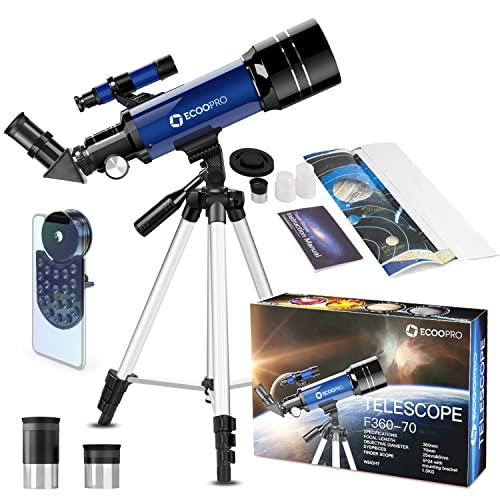
- Crisp, Vivid Views: Explore the cosmos with stunning clarity using the 70mm large aperture and fully...
- Powerful Magnification for Endless Discovery: Comes with two premium Kellner eyepieces (K25mm...
- Engineered for Quick, Tool-Free Operation: Get observing right out of the box with the...
Pros
- 70mm aperture
- Compact 360mm focal length
- Two eyepieces included
- Finder and tripod included
- Simple tool-free setup
Cons
- Limited planetary detail compared with larger telescopes
- Lightweight mount is better at modest magnification
Trade-offs / Who should skip:
Choose a larger telescope if you already know astronomy will become a serious hobby. ECOOPRO is better for testing the waters at a lower cost.
Koolpte 70mm/500mm AZ Refractor — Best for Kids and Families
The Koolpte combines a 70mm aperture and 500mm focal length with a simple altazimuth mount. It is specifically positioned for children and beginners observing the Moon and landscapes and includes a phone adapter, remote, and carrying case.
Its uncomplicated design makes it a practical telescope for parents and children who want to explore the sky together without a complicated computerized setup.
Why it wins: It combines beginner-friendly controls, useful starter accessories, and a particularly deep customer-review history for a family-oriented telescope.
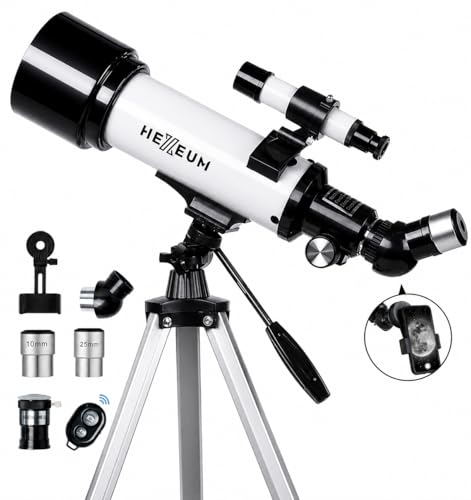
- High-Quality Optics: The astronomical telescope features 500mm(f/7.1) focal length and 70mm...
- High Magnification: Our durable telescope for kids and adults is quipped with two excellent-quality...
- Portable and Convenient: Telescope comes with a phone adapter and an adjustable aluminum tripod...
Pros
- 70mm aperture
- 500mm focal length
- Simple AZ mount
- Phone adapter and remote included
- Carrying case included
Cons
- Smaller aperture than the premium options
- Limited for faint deep-sky targets
Trade-offs / Who should skip:
Choose the ECOOPRO if keeping the initial cost as low as possible is the main goal. The Koolpte is better for families that value the included phone accessories and portable case.
Quick Compare
- Celestron NexStar 102SLT: best overall beginner telescope.
- Hawkko 90mm/900mm: best for manual Moon and planet viewing.
- MEEZAA 150EQ: best premium reflector.
- EACONN 80mm/600mm: best travel telescope.
- SARBLUE Mak70: best compact planetary telescope.
- ECOOPRO 70mm/360mm: best budget starter.
- Koolpte 70mm/500mm: best for kids and families.
Final Verdict
The Celestron NexStar 102SLT remains the strongest all-around choice for beginners who want meaningful aperture plus computerized assistance locating celestial objects.
For uncomplicated manual observing, the Hawkko 90mm/900mm is particularly appealing for the Moon and planets. The MEEZAA 150EQ is the more advanced step-up option for beginners interested in learning a Newtonian reflector and equatorial mount.
Choose the EACONN for travel, the SARBLUE Mak70 when compact planetary viewing is the priority, and the ECOOPRO for a low-cost introduction. For children and shared family observing, the Koolpte 70mm/500mm offers a straightforward package with beginner-friendly accessories.
As an Amazon Associate, I earn from qualifying purchases.